
Ford County VINELink Coverage
Kansas brands the service Kansas VINE and provides access through VINELink. It is free, confidential, and voluntary. The Ford County Sheriff promotes it for county-jail information. Current official state material makes the scope clear: Kansas VINE covers people housed in Kansas county jails, including the Ford County Jail, and expressly excludes Kansas Department of Corrections prisoners. The service can report a custody status, location, scheduled release date when available, and selected custody changes.
That boundary prevents a common search error. A person transferred from the Ford County Jail to KDOC may leave the VINE county-jail channel without returning to the community. KASPER becomes the state-prison source. A federal sentence belongs in the Bureau of Prisons locator, while current qualifying immigration detention belongs in ICE’s locator. VINELink does not merge those systems.
Ford County maintains an official Victim Notification page and hosts a Kansas VINE fact sheet. Those local sources are more than a generic link: they document the county-jail data route, the search inputs, registration steps, and transfer cadence that apply to a Ford County VINELink check.
Search Ford County VINELink Records
Use VINELink for one named Ford County Jail detainee, not as a list of everyone released. Registration works best while the matched person is still shown in custody. Start with the offender identification number when it is known. If only a name is available, check every returned identifier and the listed location before opening a record. Similar names are not rare.
- Open the official Kansas VINELink portal or call 1-866-574-8463.
- Select Kansas and search by the person’s full name or offender identification number.
- Compare the offender number and location. The matching record should point to the Ford County Jail when that is the custody setting being checked.
- Read the current custody status and location. Note a scheduled release date only if the record actually supplies one.
- If the result reports release, transfer, or no longer in custody, confirm exact timing and destination with the Sheriff or court before stating what happened.
The official Kansas search interface is shown below. It is linked from the same Kansas VINELink source used to begin a Ford County inmate check.
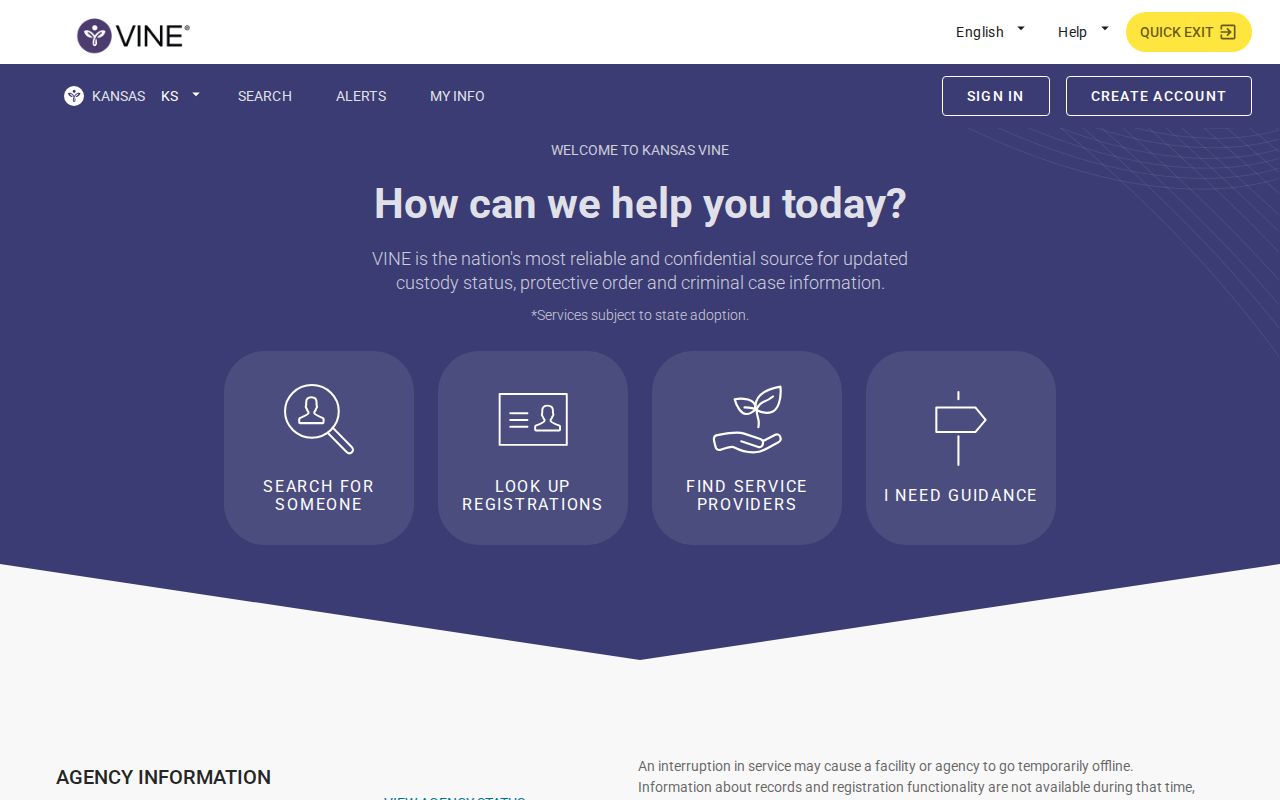
The interface documents how to start a specific-person search without turning the result into a claim about an unverified release destination.
Note: A no-result can reflect spelling, timing, transfer, system scope, or an older record and does not prove release.
Ford County VINELink Release Fields
The Ford-hosted fact sheet identifies the core fields available from the county-jail feed. Read them together. A name without an offender number may point to the wrong person. A scheduled date is forward-looking and can change. A current location may explain a transfer, but a durable record of the Ford County event still comes from Sheriff Records.
| VINELink field | What it supports |
|---|---|
| Offender name and number | Identity matching within the county-jail system |
| Current custody status | The status last supplied to Kansas VINE |
| Location | The reporting county-jail facility or transfer context when supplied |
| Scheduled release date | A date shown when available, not a guaranteed exit time |
| Notification options | Available phone, text, email, app, or TTY alert channels |
Official materials do not establish the exact completed-release label or how long a released Ford County record remains searchable. VINELink must not be described as a release archive. It is also not an official release certificate. If an exact release time, release type, or receiving destination matters, request the Ford booking and custody-event record.
Ask Sheriff Records for an existing booking, release, disposition, or transfer entry tied to the correct person and date range. Useful request terms include the actual release or transfer date and time, the recorded type, and the destination. These are items to request, not claims that every field appears on a public Ford County form. If a field is withheld, the custodian can identify the legal basis that applies.
Released and still-in-custody results require different next steps. A current Ford County Jail status can support alert registration. A release or transfer notice calls for agency verification. If a transfer destination is KDOC, use KASPER. If the person is still in county custody, the live jail line and VINE answer current-status questions, while the court docket explains bond or other legal authority.
Register Ford County Release Alerts
Registration should occur while the Ford County person appears in custody. Kansas VINE offers channels that may include phone, text, email, app, and TTY. The Ford fact sheet and the official Kansas instructions describe release, transfer, and escape notices. Choose the channel that can be checked promptly, and keep the telephone PIN private.
- Open the verified person record and choose registration or notification.
- Select an offered channel and enter the phone number, email address, or other destination.
- For telephone alerts, create a four-digit PIN that can be recalled when the automated call arrives.
- Listen to the full call, then enter the PIN followed by the pound sign. Acknowledgment stops repeat calls.
- Email requires no PIN and sends one email for the custody change. After a transfer, register again when the notice instructs you to do so.
A notification is an alert to check the underlying record. It can arrive before another public system has updated, or after a receiving agency has taken custody. Do not substitute the alert time for the physical release time. The Sheriff’s custody-event record, a court order, and the receiving-system result each answer a different part of the event.
Keep registration details accurate. A wrong number or full mailbox can defeat the purpose of the alert. Phone acknowledgment also matters because the system may continue calling until the PIN is entered. Email produces a single message, so it should be monitored directly rather than assumed to repeat.
Ford County VINE Feed Timing
Ford County’s hosted fact sheet says county-jail data transfers to VINE every 15 minutes around the clock. That cadence is a useful local detail, but it is not continuous. Booking staff must first enter or change the source record, and the next transfer must then reach VINE. A very recent event may therefore lag even when the service is operating as designed.
Wait for the next transfer cycle, check spelling and the offender number, and then call the Ford County Jail at 620-227-4501 if the question is urgent. Never turn an empty search into a firm release statement. The official Ford Population Log has also warned that recent status changes may not be reflected, so comparing two online no-results does not create proof.
The 15-minute finding is specific to Kansas county-jail data described in the Ford-hosted material. It does not describe KASPER, BOP, ICE, or court updates. Those systems have their own scope and timing. A county VINE result should not be used to infer the status of a state-prison or federal case.
Note: The Ford County feed interval is frequent but not instant, so direct confirmation remains essential for a same-day event.
Confirm Ford County VINELink Releases
When VINELink reports a Ford County custody change, identify whether it says release, transfer, or another event. A transfer does not mean the person returned to the community. Search KASPER if the destination is the Kansas prison system. Use the BOP locator for a sentenced federal transfer. ICE’s locator addresses current qualifying immigration detention, but a no-result there does not prove release.
For the local event, contact the Ford County Jail or send Sheriff Records a precise request for the booking and release, disposition, or transfer entry. Ask for the actual date and time plus the recorded destination when held and disclosable. The Ford criminal docket can provide the bond, dismissal, sentence, or other court authority, but an order timestamp is not always the time the person crossed the jail threshold.
The full custody-system sequence and records-request path appear in the Ford County released-inmate lookup. That broader check is useful after a VINE alert because it separates county release, state transfer, federal custody, and court disposition instead of forcing one notification to answer all four questions.
Use KASPER, not VINE, for a state-prison discharge. KASPER can show incarceration, parole, postrelease supervision, or “Discharged,” along with KDOC’s exact forward-looking label, “Anticipated release date.” For BOP custody, use the federal locator. Kansas VINE remains the Ford County Jail alert tool.
The Kansas offender registry is another source that must not be confused with VINELink. It covers only people with a duty to register under Kansas law, not all released Ford County inmates. A registry entry may show registration information for that limited group, but it does not prove a recent release date or replace the custody-event record.
Court records provide legal context after an alert. The statewide CaseSearch can show a Ford County bond order, dismissal, sentence, probation, revocation, or discharge. Online entries are nonofficial and may not state the moment of physical release. Compare the case number and identity, then obtain an official court copy when the order itself matters.
Federal and immigration channels remain separate. A BOP result marked “RELEASED” supports the end of Bureau of Prisons custody on the displayed date, not freedom from every authority. ICE’s ODLS is a current-custody tool with important exclusions and no historical release archive. Neither system feeds Ford County Kansas VINE.
This source-by-source approach gives each record a limited job. VINE supplies the county-jail alert. Sheriff Records documents Ford’s custody event. The court explains the legal authority. KASPER, BOP, or ICE addresses a receiving system when transfer is possible.
Keep the alert message and the time it arrived when later agency confirmation is needed. That detail can help frame a narrow request without turning the notification timestamp into the claimed release time.