
Ford County Projected Versus Actual
A projected date is a calculation based on the sentence, applicable credits, and known legal status. It is not the same as the actual custody-end event. KDOC uses the exact label “Anticipated release date” in KASPER, its Kansas Adult Supervised Population Electronic Repository. That wording matters. The date points forward and may move. An actual release record states what occurred, including the recorded time, type, or destination when those fields are held and disclosable.
A Ford County pretrial detainee has no sentence-based projected release date. Release may depend on bond, dismissal, a later court order, completion of processing, and any other hold. Even a bond order can precede physical departure. A sentenced county-jail inmate may have a release calculation, but Ford County publishes no jail good-time formula or public projected-date field. The jail records unit and court are the proper sources rather than an estimate made from the booking date.
Transfer must also remain separate from release to the community. Departure from Ford County Jail for KDOC, another jail, federal custody, or immigration custody ends the local roster entry without establishing freedom. A receiving-system result and Ford’s transfer entry clarify what happened next.
Find Ford County Projected Release Dates
Classify the custody system before searching. KASPER covers people sentenced to the Kansas Secretary of Corrections since 1980 who are incarcerated, under post-incarceration supervision, or discharged. It does not reconstruct an ordinary Ford County Jail stay that never became a KDOC sentence. The county path runs through the jail and District Court instead.
- For a Kansas prison sentence, open the official KASPER search. Use the KDOC number when known or search by name.
- Add the middle name, alias option, birth date, and Ford as conviction county to distinguish similar records. Open the record only after comparing identifiers.
- Read the exact “Anticipated release date” field along with custody level, movement history, and supervision status. Capture the date checked because KASPER updates.
- For a Ford County Jail sentence, call 620-227-4501 and review the Ford County criminal case for the sentence and later orders. Ask Sheriff Records for the existing custody-event record.
- If the computation is disputed or unclear, contact KDOC’s Sentence Computation Unit at 785-296-3317 for a state sentence rather than calculating it independently.
The KDOC locating page describes the fields and the discharged-sentence coverage shown in the official image below.
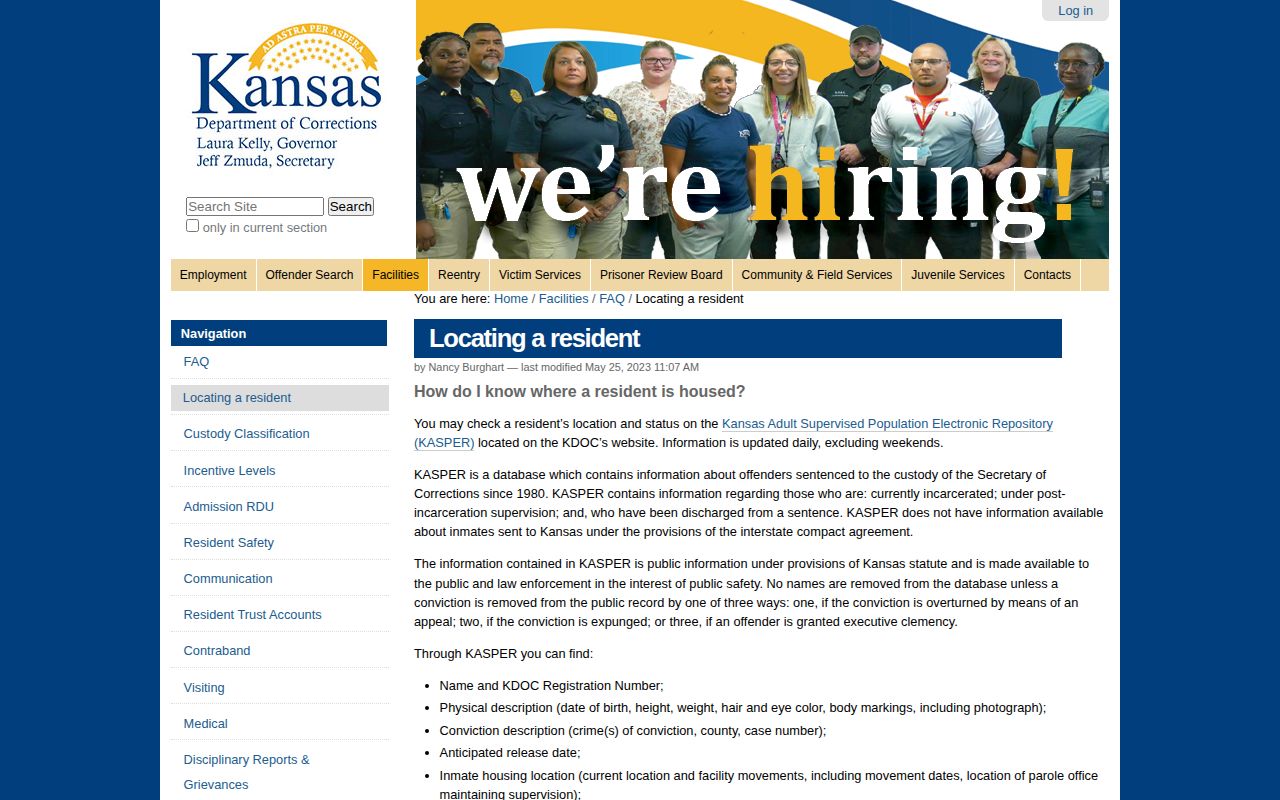
This source confirms KDOC’s “Anticipated release date” terminology and helps separate a state-prison calculation from an unsupported county-jail estimate.
The broader Ford County released-inmate search path can be used when the custody system is uncertain. It compares county, state, federal, court, and notification sources without treating roster absence as proof.
Note: Record the date of every KASPER check because later credits, orders, or status changes can replace an older result.
Ford County Kansas Sentence Credits
Good time is credit allowed under law and corrections rules that can reduce the period served before an anticipated date. Program credit may also apply to qualifying Kansas sentences. It is safer to read the current KASPER calculation than to subtract a single percentage from the term. Offense date, severity, sentence type, eligibility, program participation, and forfeiture can change the result.
K.S.A. 21-6821 supplies the controlling limits discussed in the Ford County research. Many determinate categories have a 15 percent good-time cap, which is the source of the common “85 percent” shorthand. Other categories can have a 20 percent structure. Additional program credit may be possible in eligible cases, while exclusions apply. The shorthand is therefore not a universal Kansas truth-in-sentencing formula.
KDOC calculates its own sentence dates. Credits may be earned, withheld, restored, or forfeited under the applicable rules, and KASPER warns that dates can change. The Sentence Computation Unit is the authoritative state contact. A family calculation based only on the pronounced sentence can miss jail credit, consecutive terms, offense-specific limits, disciplinary action, or a later court order.
No official Ford County Jail good-time formula was found. Do not apply the KDOC statute and state-prison method to a local jail sentence by analogy. Ask the jail records unit what date is recorded, then compare the judgment and any sentence-credit entries in the Ford County District Court case.
Ford County Release Date Changes
An anticipated date can move earlier or later as the legal and corrections record changes. Some factors alter the sentence calculation. Others do not change the sentence endpoint but prevent a person from returning to the community on that day. A detainer, for example, is a request or legal hold from another authority. It can send the person to a new custodian even when Ford or KDOC custody ends.
| Factor | Possible effect | Best confirmation source |
|---|---|---|
| Good-time or program credit | May advance the anticipated date within legal limits | KASPER and KDOC Sentence Computation Unit |
| Disciplinary forfeiture | May delay the computed date | KDOC calculation and disclosable disciplinary record |
| New or corrected court order | Can alter the term, credit, or authority for release | Ford County District Court record |
| Detainer or warrant | Can cause continued custody or transfer after one sentence ends | Holding and receiving agencies plus court |
| Parole decision | Can grant, continue, or pass an eligible indeterminate case | Prisoner Review Board record and later KASPER status |
| Placement approval | Can affect release logistics even after a date is calculated | KDOC Parole Services |
Parole eligibility is not the same as parole approval. Under K.S.A. 22-3717, sentence structure and offense/date rules control eligibility. The Kansas Prisoner Review Board can grant parole, continue a matter for more review, or pass it for a stated period. A schedule listing shows review timing, not a final release decision.
For post-1993 determinate cases, the board ordinarily sets postrelease conditions and handles revocation instead of choosing the initial prison-release day. KASPER’s parole, conditional release, or postrelease status means physical prison exit with supervision continuing. “Discharged” marks a later and stronger sentence endpoint.
The board’s public-comment schedule runs on a monthly cycle and may list a resident by facility, commitment name, KDOC number, county of offense, case number, and offense. A listing does not prove approval. “Continue” means more review, information, votes, or evaluation is needed. “Pass” means parole was denied for a stated period. Only a grant, followed by eligibility and completed release logistics, supports a planned parole exit.
Kansas Weekend Release Rule
Kansas has a distinctive KDOC processing rule for dates that fall on a weekend or department holiday. The K.A.R. 45-400-3 reproduction states that a KDOC release date falling on Saturday, Sunday, or a KDOC holiday may be processed on the preceding workday. Parole placement approval can still affect the logistics.
This rule belongs to KDOC. No Ford County Jail weekend-release policy, public processing schedule, or comparable local rule was found. A person serving a county-jail sentence should not be promised an earlier weekday departure based on the state-prison regulation. Call the jail and read the controlling court order.
The date shift also does not answer destination. A KDOC release can begin parole or postrelease supervision, or another hold may route the person elsewhere. Check the KASPER status and movement information after processing. When exact proof is needed, obtain the agency record rather than relying on an older anticipated-date screenshot.
Note: Kansas’s preceding-workday rule is a KDOC rule and is not evidence of Ford County Jail weekend practice.
Confirm Ford County Release Dates
Use the agency that controls the custody. For a KDOC prisoner, recheck KASPER after the next working-day update and contact the Sentence Computation Unit when the anticipated date is in doubt. For a Ford County Jail detainee, call the jail and obtain the Sheriff’s release or transfer event. Review the court file for the bond, sentence, dismissal, or other order that authorized the change.
Kansas VINE can notify on Ford County Jail release or transfer events, but it expressly excludes KDOC prisoners. Register while the person is shown in county custody. The Ford County VINELink check explains search fields, phone PIN acknowledgment, and the locally documented feed cadence. An alert is not a release certificate and should be paired with the source record.
If an anticipated date passes while KASPER still shows incarceration, do not announce an error or release. Credits may have changed, a disciplinary forfeiture or new order may exist, or the screen may be waiting for its next working-day update. Contact KDOC rather than recalculating from the sentence alone.
Finally, distinguish prison exit from sentence discharge. Parole and postrelease supervision indicate that confinement ended while legal supervision continues. A KASPER “Discharged” status supports completion of the KDOC sentence. Neither status rules out a separate Ford County, federal, or immigration matter, so a complete answer may require more than one custody system.
Ford County court records add durable context. Search the statewide district CaseSearch with Ford County and Criminal selected, then compare party name, birth date, case number, and filing dates. Look for the judgment, sentence, bond order, dismissal, probation, revocation, or satisfaction. The portal warns that its online information is nonofficial, and a filed order may not record the exact physical exit time.
When the portal is not enough, obtain the official order from the District Court clerk. Pair it with the Sheriff custody-event record for a county jail release. This two-record method separates legal authority from actual processing. It also reveals why a court date and a jail departure date may differ even when both records are correct.
For a federal sentence connected to Ford County, KASPER is not the source. The BOP locator can display a future or past federal release date and the location value “RELEASED.” BOP cautions that another justice system or supervision may still apply. Immigration custody likewise requires its own current locator and agency follow-up.
Every no-result should be read cautiously. A name variation, sealed or expunged material, interstate-compact exclusion, recent update, or wrong custody system can explain it. Recheck identifiers and ask the responsible office rather than turning a missing row into a release-date claim.
Use the same restraint with old screenshots. Dynamic dates can change after capture. A saved image should retain its capture date and source, while the current agency record controls any present-tense statement about a Ford County release.