
Ford County Parole Versus Probation
Parole and probation may both place rules on a person living in the community, but they arise from different parts of a Ford County case. Kansas parole applies to a person released from prison under an indeterminate sentence structure. Mandatory postrelease supervision follows many determinate Kansas prison terms. Both are state supervision handled through the Kansas Department of Corrections. Probation is a court sentence or condition that permits community supervision instead of, or after a limited period of, confinement. Ford County’s named intensive-supervision probation agency is Santa Fe Trail Community Corrections.
The label matters because it points to the right record. KASPER, the Kansas Adult Supervised Population Electronic Repository, can show parole, conditional release, postrelease supervision, and a parole office for a KDOC case. A Ford County District Court docket can show the order that placed a person on probation. Santa Fe Trail Community Corrections holds its own current community-corrections information. KASPER warns that community-corrections probation events after April 21, 2021 cannot be displayed, so a blank or old KASPER entry is not enough to rule out local probation.
| Supervision | How it begins | Ford County verification path |
|---|---|---|
| Parole | Release from an eligible indeterminate Kansas prison sentence | KASPER, then the Dodge City Parole Office |
| Postrelease supervision | Statutory supervision after many determinate prison terms | KASPER and KDOC Parole Services |
| Probation | Order of the District Court in a criminal case | Ford County court record and Santa Fe Trail Community Corrections |
None of these labels alone proves current incarceration. A person on supervision has usually left confinement. A violation, warrant, or absconder entry calls for a fresh check with the agency and court rather than an assumption that the person is back in the Ford County Jail.
- Parole
- Conditional community release from an eligible prison sentence before final discharge.
- Postrelease supervision
- A required period of KDOC supervision after release from a determinate prison sentence.
- Probation
- A court-ordered community sentence with conditions and supervision.
- Discharge
- The formal end of a sentence or supervision term.
Verify Ford County Post-Release Supervision
Begin with the sentence source, not with a live jail roster. Ford County Jail’s current population display addresses present county custody and cannot show the full course of supervision after release. A Kansas prison case belongs in KASPER. A probation order belongs in the Ford County criminal docket and the assigned community-corrections office. Use a full name plus an identifying number, birth date, or case number to reduce the risk of matching a different person.
- Search KASPER by KDOC number when known. Otherwise use the name fields, alias option, birth date, and Ford as conviction county.
- Open the matching KDOC record only after comparing identifiers. Read the custody or supervision level, movement history, and listed parole office.
- If KASPER shows parole, conditional release, or postrelease supervision, contact the Dodge City Parole Office to confirm the current assignment when timing matters.
- For probation, search the Kansas District Court CaseSearch with Ford County and Criminal selected. Look for the sentence, probation, revocation, or discharge entry.
- Contact Santa Fe Trail Community Corrections for current intensive-supervision probation information that the agency may disclose. Do not treat a KASPER no-result as proof that no probation exists.
The online court portal labels its information nonofficial. When the exact order or discharge is important, request an official copy from the court clerk. For the broader jail-release record and search path, use the Ford County released-inmate search. That record can establish when Ford County custody ended, while the supervision source establishes what followed.
Kansas VINE is not a supervision lookup. It reports Ford County Jail custody changes and specifically excludes KDOC prisoners. A VINE alert may help mark the end of a local jail stay, but it cannot tell whether a later state sentence is on parole or whether Santa Fe Trail Community Corrections supervises probation. Keep the alert as one event, then use the sentence and supervision records for the next stage.
Note: Match the case or KDOC number before relying on a supervision result because common names can produce the wrong record.
Ford County Parole Office Details
KDOC assigns Ford County state parole and postrelease cases through its South region. The official parole office directory identifies the Dodge City office and says it serves Clark, Ford, Gray, Hodgeman, Lane, and Ness counties. KASPER may name the office attached to an individual record, which is the best way to avoid calling a nearby office that does not hold the case.
KDOC Dodge City Parole Office208 W. Spruce
Dodge City, KS 67801
620-225-1233
Call the office to confirm the responsible supervision unit when KASPER has not yet caught up with a move or status change. The repository updates on working days. That cadence can leave a weekend event or same-day reassignment out of view. The office can address its own supervision records, but it is not the source for a Ford County Jail release time or a District Court probation order.
The Kansas Prisoner Review Board has a different role. It makes parole decisions under the older indeterminate structure, sets conditions, handles revocation, and may discharge a successful supervisee on recommendation. For many post-1993 determinate sentences, release to postrelease supervision is mandatory under the sentence structure rather than a discretionary parole grant.
The official Prisoner Review Board schedule is a rolling monthly public-comment calendar. A listed person has not necessarily been granted parole, and conviction county need not be the county where the person will live. No public person-level decisions database was found. KASPER and a direct board-record request are the sound follow-up channels.
The schedule interface below comes from the official Prisoner Review Board source and shows how the monthly cycle is presented.
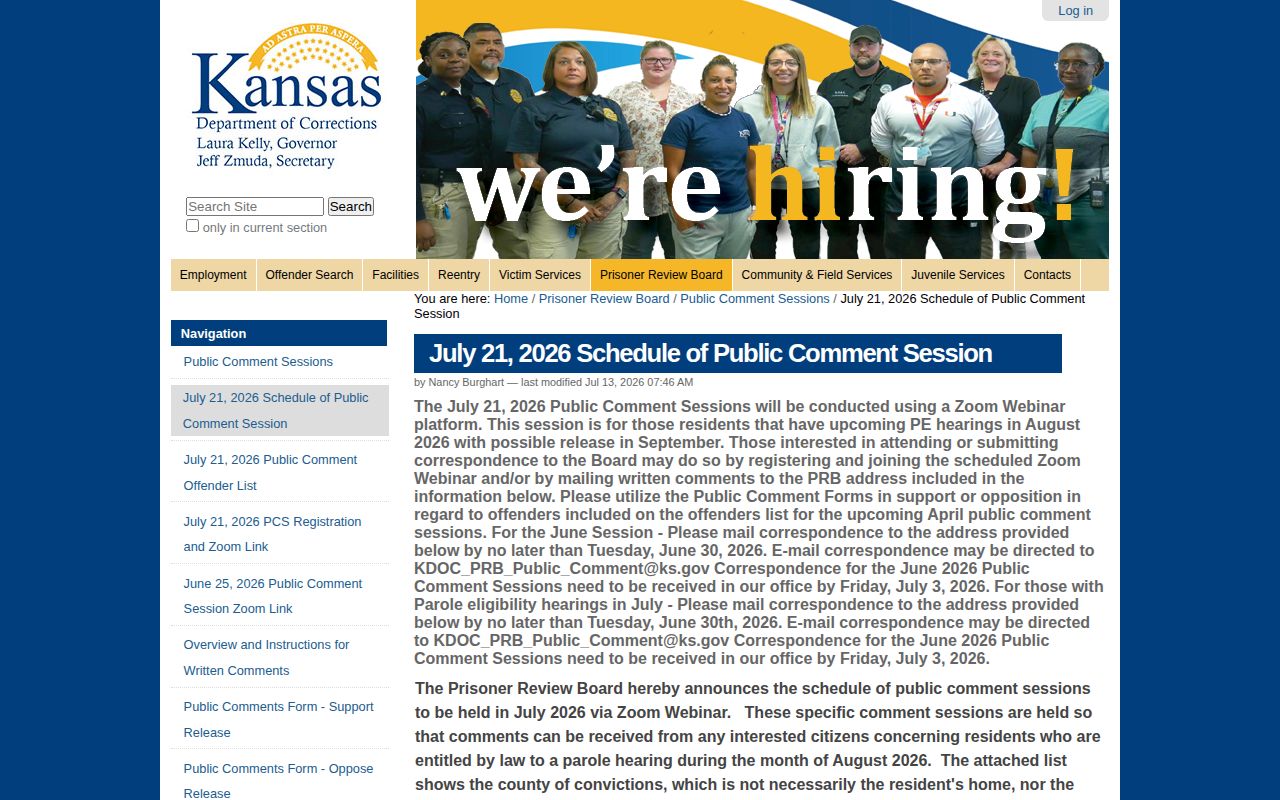
Use the schedule only to identify the review cycle, then verify the individual outcome through KASPER or the board rather than treating a calendar listing as release approval.
Ford County Probation Office Path
Santa Fe Trail Community Corrections is Ford County’s local adult felony intensive-supervision probation channel. The agency is funded and overseen through KDOC, the Ford County commissioners, and its advisory board, yet it is not KDOC Parole Services. Its official county page lists 620-227-4564. This division explains why a person may have a state court probation case without an up-to-date community-corrections event in KASPER.
Santa Fe Trail Community CorrectionsFord County intensive-supervision probation
620-227-4564
First read the sentencing entry in the Ford County District Court case. It identifies the legal basis for probation and may later record revocation or discharge. Then ask Santa Fe Trail Community Corrections about the current supervision record to the extent it can be released. A court order and an agency status serve different purposes: the order creates or changes probation, while the agency manages day-to-day supervision.
Probation must not be used as shorthand for parole. A person can receive probation without entering KDOC prison. Conversely, a person leaving a Kansas prison on parole or postrelease supervision belongs to KDOC Parole Services even if the supervising office is in Dodge City. That local overlap is geographic, not legal.
Ford County Absconder Record Checks
KASPER maintains separate parole absconder and community-corrections absconder channels. An absconder is a person alleged to have knowingly avoided supervision or made their whereabouts unknown. Kansas law allows KDOC to issue a warrant, and time away from supervision may not count toward the term. The listing signals a supervision problem. It does not establish a new conviction, present jail custody, or the outcome of the allegation.
Ford County Sheriff’s official CRIMEWATCH portal can carry local warrant and most-wanted posts. Those posts are leads, not a complete Kansas supervision index. Check the responsible supervision agency and the court. If immediate safety or active-warrant information is needed, use law enforcement rather than attempting contact with the listed person.
The official absconder page below shows the filters available for state parole cases.
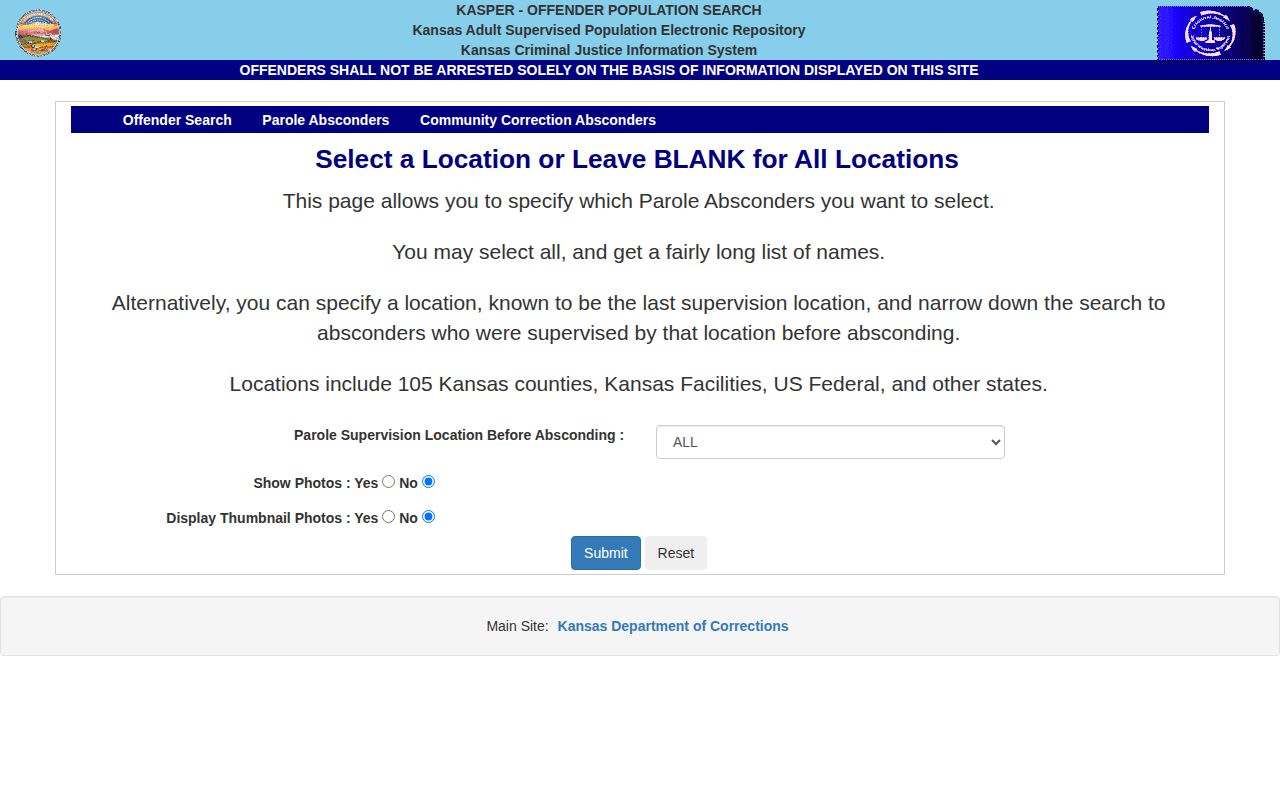
Because KASPER updates on working days, verify an urgent Ford County parole or probation status directly before drawing a present-tense conclusion.
Note: An absconder entry concerns supervision status and does not by itself show that the person is in custody.
Ford County Supervision Discharge Records
Supervision ends through a formal discharge, not merely because a person has stopped appearing at an office or no longer seems to be listed online. For a KDOC sentence, “Discharged” in KASPER is stronger evidence that the state sentence has ended than parole or postrelease status. The Prisoner Review Board may discharge certain successful supervisees on recommendation. For probation, the Ford County court file may contain the discharge or satisfaction entry.
Kansas Supreme Court Rule 108 treats a criminal case as open until the proceedings and appeals end, the sentence expires or is satisfied, and the defendant is discharged. The court record can therefore preserve the legal sequence after a live custody display has changed. KASPER also retains discharged KDOC cases in its stated scope, though records can be affected by an overturned conviction, expungement, or clemency.
Read each endpoint narrowly. Discharge from KDOC does not certify the absence of an unrelated county, federal, or immigration matter. Completion of Ford County probation does not provide the exact prior jail exit time. When both facts matter, pair the discharge order or status with the relevant custody-event record.
A record request should identify the person, case or KDOC number, and the precise discharge or status document sought. Narrow terms help the clerk or agency locate an existing record. Kansas open-records law does not require an office to create a new explanation or custom report, so ask for the order, status history, or discharge record that already exists.